

AFH Club · Costs & Fees
AFH Costs & Fees in Washington State
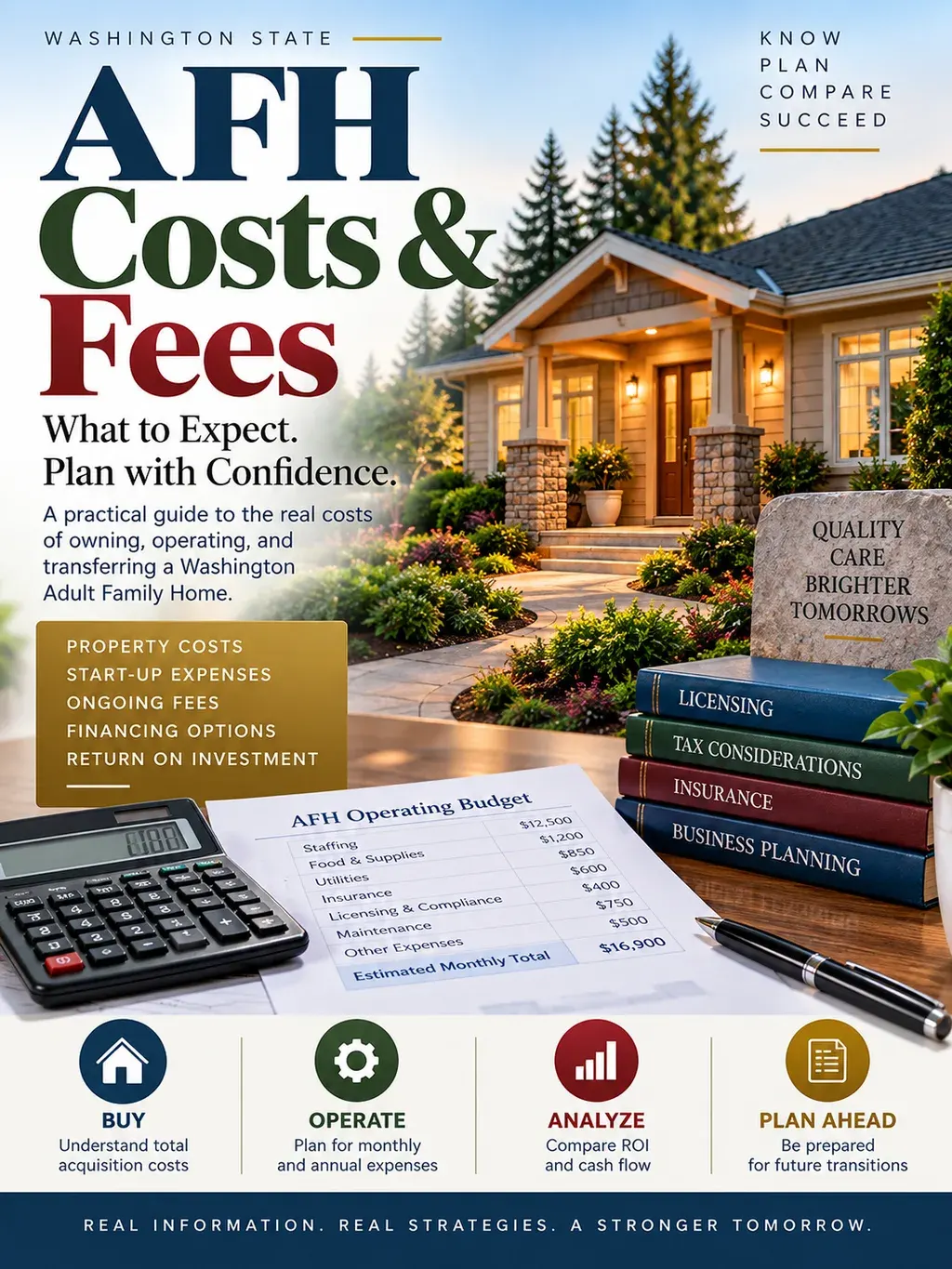
Opening an Adult Family Home involves a range of startup costs that can surprise unprepared applicants. This page breaks down fees, licensing costs, and ongoing expenses, with the rule or agency behind each one, so you can plan with clear eyes.
Annual license fee: $450 per licensed bed per year since July 2025, or $2,700 for a six-bed home. It is set in the state budget every two years and can change. DSHS bills 60 days before your license anniversary month; pay it on time every year.
Startup & Ongoing
Cost Breakdown
Total startup costs before first revenue depend on the condition of the home, the training you already have, and your jurisdiction's permit fees. Building modifications are usually the largest and most variable expense.
DSHS Annual License Fee
$450 per bed per year$450 per licensed bed, in place since July 2025 (DSHS, in writing, September 2026). A six-bed home pays $2,700 a year. The amount is set in the state budget the Legislature passes every two years, so it can change; DSHS announces changes in provider letters. DSHS mails a billing statement 60 days before the home's license anniversary month, and the fee is due that month. Unpaid annual fees were the second most-cited adult family home deficiency in DSHS's most recent published list (fourth quarter of 2024).
Source: DSHS written answer, Sept 2026; RCW 70.128.060; WAC 388-76-10025
DSHS Application & Processing Fees
Set in the state budgetFees must be paid with the application. The processing fee applies to every application, including a new license, a change of ownership, and a change of location. Confirm current amounts with DSHS.
Source: WAC 388-76-10070; WAC 388-76-10073
Background Checks
VariesThe applicant, anyone affiliated with the applicant, entity representatives, resident managers and caregivers need a Washington State name and date of birth check and a national fingerprint check. Household members over age 11, volunteers and noncaregiving staff with unsupervised access need the name and date of birth check. The name and date of birth check must be renewed every two years; the fingerprint check does not expire.
Source: WAC 388-76-10161; WAC 388-76-10165
Home Care Aide Training (75 hours)
Varies by training providerTuition varies by training provider. The Long-Term Care Foundation's Adult Family Home Training Network covers training and testing for employees of Medicaid-contracted homes that have at least one Medicaid resident; it is not a way for a new applicant to fund their own training.
Source: Chapter 388-112A WAC
Home Care Aide Certification (DOH)
$100 applicationThe Department of Health charges $100 to apply for Home Care Aide certification and $100 to renew. The exam is scheduled and paid for separately; check DOH for the current exam process and fee.
Source: WAC 246-980-990
AFH Administrator Training
Varies by collegeAt least 48 hours of instruction from an approved community college. Required of applicants and entity representatives.
Source: WAC 388-112A-0800; WAC 388-76-10064
CPR & First Aid
VariesRequired of the provider, entity representative and resident manager. Cost varies by course provider.
Source: WAC 388-76-10130
Building Modifications
Varies widelyDepends almost entirely on the house. Ramps, bathroom modifications, escape windows, and smoke and carbon monoxide alarms are common. DSHS warns that septic system improvements can carry significant costs.
Source: WAC 51-51-0330
Remodel & Building Permits
Varies by jurisdictionPermit fees vary by jurisdiction and scope of work. Some jurisdictions have flat AFH permit fees; others charge by project cost.
Source: Local jurisdiction
Liability Insurance
About $2,840/year (6 beds, 2024 average)Required by WAC 388-76-10191, with minimum limits of $500,000 per occurrence and $1,000,000 aggregate. The Insurance Commissioner's 2025 study found the average annual premium was $318 per bed in 2019 and $473 per bed in 2024. At the 2024 average, six beds is about $2,840 a year (about $1,900 at the 2019 average). Some insurers have training and experience requirements beyond DSHS minimums.
Source: WAC 388-76-10192; WA OIC 2025 study
Business Registration
$50 + endorsementsThe Department of Revenue charges a $50 processing fee to open a new business license, plus any city or state endorsement fees. Forming an LLC with the Secretary of State costs $180 plus an online processing fee.
Source: WA Dept. of Revenue; WA Secretary of State
Important Note
Liability Insurance — Plan Ahead
Liability insurance is required for all licensed AFHs under WAC 388-76-10191 through 10192: commercial general liability and professional liability, each with limits of at least $500,000 per occurrence and $1,000,000 aggregate, in place before the first resident is admitted or within 10 working days of the license, whichever comes first. A Medicaid contract may require higher limits. Coverage for AFHs in Washington comes from surplus lines insurers and risk retention groups, not the standard homeowner's insurance market.
A 2025 study by the Washington Office of the Insurance Commissioner found that the average annual premium was $318 per bed in 2019 and $473 per bed in 2024. For a 6-bed home that is about $2,840 a year at the 2024 average (about $1,900 at the 2019 average). DSHS notes that some insurers impose training and experience requirements above and beyond what DSHS requires for licensure.
Research your insurance options before applying for licensure. DSHS has noted that some homes face difficulty obtaining insurance. Insurance company requirements may affect your training timeline and startup plan. Do not wait until your license is issued to begin the insurance search.
Revenue Context
Understanding AFH Revenue
AFH revenue comes from private pay, Medicaid (for contracted homes), or a combination of both. The provider sets private-pay rates; Medicaid rates are set by the state.
Private pay
Per resident. Market rates vary by location, room and level of care.
Medicaid daily rate
Set under chapter 388-105 WAC and the state's collective bargaining agreement with the Adult Family Home Council. Depends on the resident's assessed care level, the county, and any specialty contract.
Maximum residents (standard)
Seven or eight is possible after at least 24 months of licensure and other requirements, including inspections without enforcement actions, and a sprinkler system unless every resident can evacuate without help (RCW 70.128.066; WAC 388-76-10031).
Medicaid rates are set under chapter 388-105 WAC and the state's 2025-27 collective bargaining agreement with the Adult Family Home Council, and DSHS publishes the current rate tables. Rates vary by county and care classification. Specialty contracts such as Expanded Community Services (ECS) and Specialized Behavior Support (SBS) pay more but need AFH program approval and carry additional requirements.
In late September 2026 DSHS was processing license applications received in May 2026, and it allows up to 60 days once an application is complete. Most applicants do not pass the first inspection. Homes typically do not reach full capacity immediately, so plan for a ramp-up period before revenue is stable. Consulting a CPA familiar with AFH operations before opening is strongly advised.
Key Resources
Professional Disclosure
Real Property Planning is an educational and connection hub. It does not provide legal, tax, accounting, financial, brokerage, or appraisal services. Professionals referenced on this site are independently licensed and operate through their own separate businesses. Real estate brokerage services are provided by David Stein, a licensed Washington broker, through eXp Realty. Appraisal services are provided by David Stein through Stein Appraisal. Read the full disclaimer.
Your next questions
Where do I start?
The steps to opening an adult family home in Washington, in order.
How does licensing work?
The DSHS application, provider requirements and timelines.
What training is required?
Required training for providers, resident managers and caregivers.
Will the house pass inspection?
The building and fire inspection an adult family home must pass.
How do people finance an adult family home?
Conventional, SBA and seller financing for the house and the business.
How do Medicaid payment levels work?
CARE classifications A–E, daily rates, and what changes when a home is sold.