

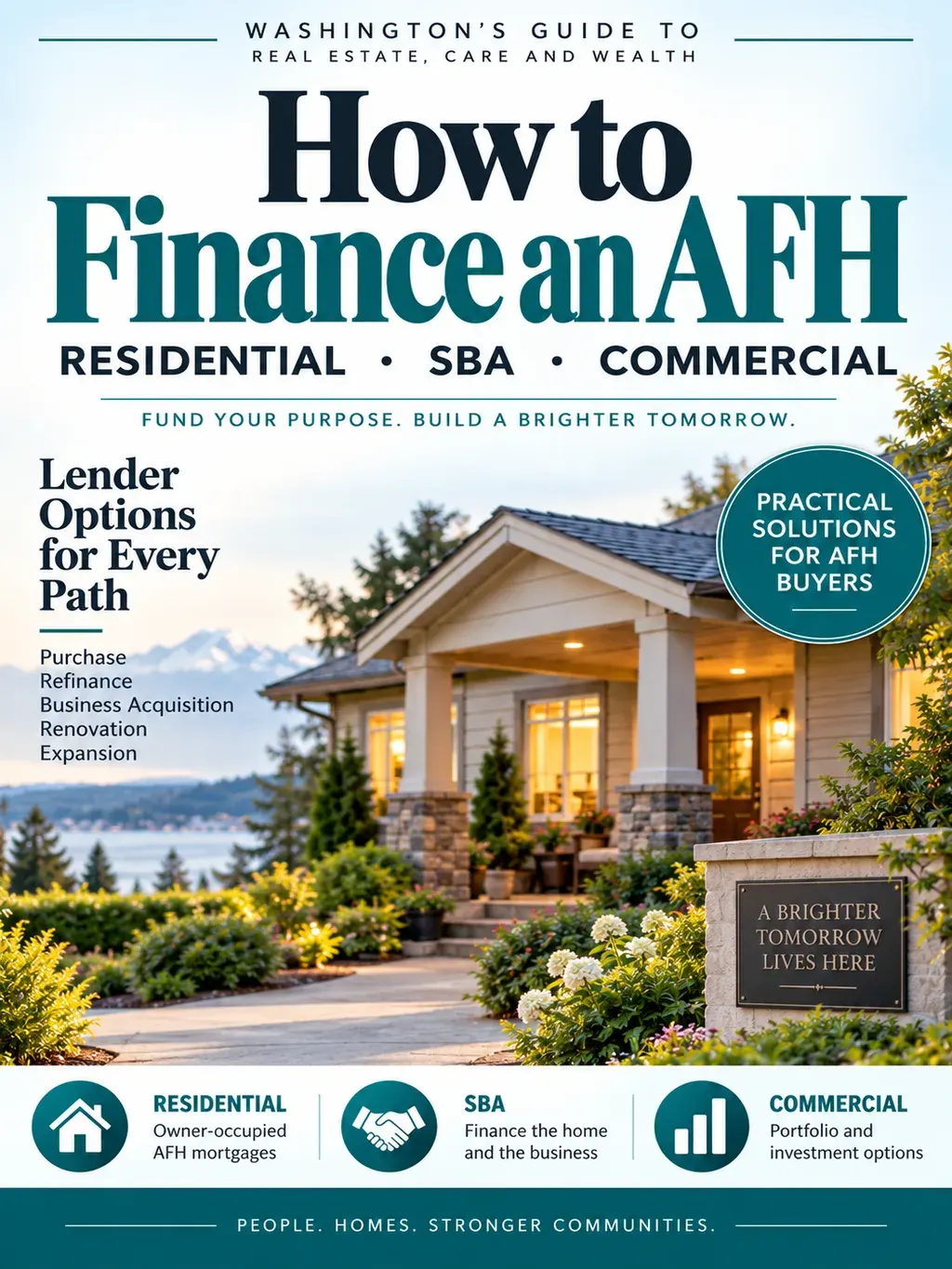
For buyers, sellers & new operators
How to Finance an Adult Family Home in Washington State
Which loan fits (a residential mortgage, SBA 7(a), SBA 504 or a commercial loan) depends on one question: are you buying a house, or a business that comes with a house?
Why an AFH is hard to finance the normal way
An adult family home is a house that runs a licensed business. When you buy a house to live in, the lender looks at your income and the house's value. When you buy an adult family home, the house is what produces the income, through a business with residents, staff, and state contracts. That puts it in a gap between two kinds of lending.
Residential lenders write loans against your personal income and a home you occupy. Many treat a licensed care business in the house as commercial use and decline; those that will lend generally do not count the AFH's revenue as your income. Commercial lenders write loans against a business's income, but on business terms: shorter loans, bigger down payments, and no appetite for the intangible part of the purchase (the license, the contracts, the residents) that a seller is charging for.
The SBA programs exist to fill exactly that gap, which is why they finance most AFH sales. But they are not the only lane, and the cheapest one, an owner-occupied residential mortgage, is often overlooked.
What are you buying?
Pick the one that fits. The lane it points to is the usual place to start, not the only option.
The four ways an AFH gets financed
Owner-occupied residential AFH financing
You will live in the home and run it yourself.
A handful of Puget Sound lenders write standard residential mortgages on licensed adult family homes when the buyer will occupy the home. It is the cheapest money available and the lowest down payment, but it is underwritten on the buyer's own qualifications, and it finances the house, not the business.
- Conventional or government-backed residential programs
- Down payments the lender publishes as low as 5% for qualified owner-occupants
- 30-year fixed terms at residential rates
- Business portion paid in cash or on seller terms
- Owner-occupancy required
- Qualifying is on the buyer's income and credit; the home's business revenue may count only partly or not at all
- Not every lender will write it; use one that says it does
SBA 7(a): business acquisition financing
You are buying the licensed operating business along with the real estate.
The workhorse for AFH purchases. A bank lends; the SBA guarantees most of it, which lets the bank accept about 10% down, a 25-year term with no balloon, and a loan that includes the business, working capital and closing costs. The price is a higher, variable rate and a slower close.
- About 10% down
- Up to 25 years, fully amortizing, when real estate is the majority of the loan
- House, business, goodwill, working capital and closing costs in one loan, up to $5 million
- Variable rate: Prime plus a spread (see the rate ceiling box)
- Guarantee fee added to the loan
- Personal guarantee from anyone owning 20% or more
- 45–90 days to close, with extensive paperwork
- Underwritten on last year's tax returns, not projections
SBA 504: owner-occupied real estate
You want a lower fixed rate on the property and can handle the business separately.
A bank loan paired with a fixed-rate loan from a Certified Development Company. About 10% down, and the CDC portion is fixed for 25 years at a rate set off Treasury yields, cheaper than 7(a). It cannot finance the business portion, so that is paid in cash or on seller terms.
- About 10% down
- CDC portion fixed for 25 years; bank portion at market
- Real estate and eligible improvements only
- Business, goodwill and working capital are excluded
- Two lenders, two closings, more time
Portfolio / commercial AFH financing
You are buying as an investor, or your file does not fit residential or SBA underwriting.
Banks lending on their own balance sheet treat an AFH as commercial property: larger down payments, shorter terms, often a balloon. Useful for investors, experienced operators buying additional homes, and buyers who need speed or flexibility that SBA does not offer.
- 25–35% down (one local lender publishes a 70% maximum loan-to-value)
- 5- to 10-year terms with a balloon, amortized over 15–20 years
- Adjustable and fixed options
- Real estate only
- Most cash at closing
- Refinance risk when the balloon comes due
- Business paid separately
Current SBA 7(a) variable-rate ceiling
SBA caps the variable rate a lender may charge at a base rate plus a spread that depends on loan size. With the WSJ Prime rate at 6.75% (as of September 17, 2026), the ceilings are:
| Loan amount | Maximum spread | Maximum rate today |
|---|---|---|
| $50,000 or less | Prime + 6.50% | 13.25% |
| $50,001 – $250,000 | Prime + 6.00% | 12.75% |
| $250,001 – $350,000 | Prime + 4.50% | 11.25% |
| Over $350,000 | Prime + 3.00% | 9.75% |
For a typical AFH purchase (a loan over $350,000), the ceiling is 9.75%. That is a maximum, not a quote; strong files price below it. SBA publishes a separate table for fixed-rate 7(a) loans. Last verified September 18, 2026.
What every lender checks
In every lane, the lender's central question is the same: will the home's income cover the loan payment? They take last year's net operating income (after operating costs and, for a buyer who will hire staff, the wages needed to replace the hours the current owners work) and divide it by the annual loan payment. Most want at least 1.25×: income one and a quarter times the payment.
Three things about that test surprise newcomers. It uses last year's tax returns, not projections. It counts every loan payment on the deal (house, business, seller note), because they are all paid from the same income. And it treats an owner-operator who will work in the home very differently from an investor who will hire staff; the same home supports a much higher price for the first.
Occupancy moves this test more than anything else. Each additional resident adds a full year of rate while adding little to costs. Two residents can be the difference between a lender declining and approving at full price. The Occupancy & Financing Calculator shows this for any home.
Some lenders, including DSCR programs, count income differently: gross resident income rather than income after expenses, averaged over two years. The same home can pass one test easily and only just pass the other. DSCR loans for adult family homes explains the difference and what to ask.
If you're buying
- Get pre-qualified in your lane before you shop. SBA closes in 45–90 days; start early.
- Ask for two years of tax returns and the resident roster with payer types. That is what your lender will underwrite.
- Ask about the contracts. ECS, SBS and DDA contracts do not transfer on a sale. Confirm you can qualify for your own before you price them in.
- Ask for a price allocation between house and business. It decides what you can finance and how.
- Consider asking for seller financing on the business. It can replace your most expensive loan.
If you're selling
- Price for the SBA buyer, who makes up most of the market. Their lender underwrites your returns and occupancy, not projections.
- Fill the beds before you list, or during it. Every resident on the returns raises the approvable price.
- State the allocation between house and business in the listing.
- Offer to carry the business portion. It widens the buyer pool and costs you little.
- Know which buyer can keep your contracts, and market to them.
For what is on the market now, see adult family homes for sale in Washington: properties, businesses, and leases, each labeled by what is actually being sold.
Real Property Planning receives no compensation from any lender listed and does not endorse or guarantee any lender, program, rate, or approval. Lenders are listed because they publish information showing they work with adult family homes; "confirmed" entries are ones David Stein has spoken with about their current AFH lending. Published terms change; verify everything with the lender. This page is general information, not lending or financial advice.
Frequently Asked Questions