

For buyers, sellers & owners
A Through E: How CARE Classifications Set an Adult Family Home's Medicaid Income
When a Medicaid client moves into an adult family home, the home does not set the price. An assessment produces a classification, and the classification sets the daily rate. One bed can be worth very different amounts.
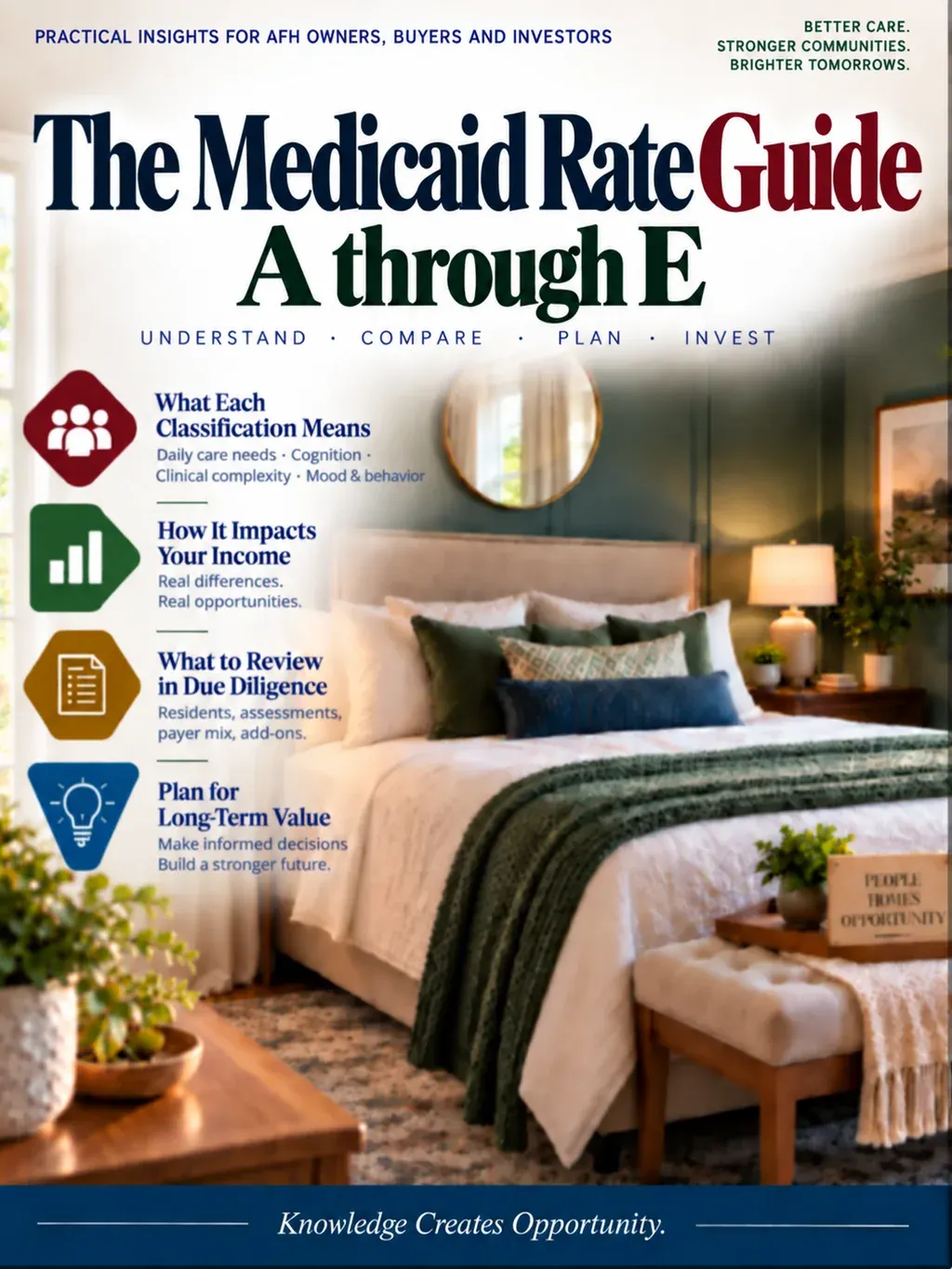
A three-part series
"Tier," "level," and "classification" get used interchangeably in AFH conversations. They are different systems, and each affects a home's income differently.
- The Field Guide
Four separate systems, who sets each one, and which survive a sale. - A Through E · you are here
The Medicaid base rate: seventeen classifications and what they pay. - CBHS Tiers
Six tiers of supportive supervision, paid on top of the base rate.
How a resident is classified
A DSHS case manager completes a CARE assessment. CARE weighs five things: cognitive performance, clinical complexity, mood and behavior, activities of daily living (ADLs), and exceptional care criteria. It places the person in a group first, then assigns a sub-level from their ADL or behavior score, working from the highest possible group down to the lowest the person qualifies for. The result is one of seventeen residential classifications.
| Group | What places a resident here | Sub-levels |
|---|---|---|
| E | Meets the exceptional care criteria | Medium, High |
| D | Clinically complex, with significant cognitive impairment (cognitive performance score of 4 to 6) | Low, Medium, Medium-High, High |
| C | Clinically complex, without that level of cognitive impairment | Low, Medium, Medium-High, High |
| B | Qualifies on mood and behavior, but not for C, D, or E | Low, Medium, Medium-High, High |
| A | Not clinically complex and no qualifying mood or behavior needs | Low, Medium, High |
Within a group, the ADL score generally sets the sub-level. In Group C, for example, High is an ADL score of 25 to 28, Medium-High is 18 to 24, and Medium is 9 to 17.
The letters are not a ladder
Residents do not progress from A to B to C. The letters describe different combinations of need. A physically frail resident with no behavioral or medical complexity can be A High, while a physically capable resident with serious behaviors is a B. And these are classifications, not "tiers": the numbered tiers owners talk about are a separate program, covered in CBHS Tiers Explained.
What the classifications pay
Rates effective July 1, 2026. In King, Pierce, and Snohomish counties, the base adult family home rate runs from $144.47 to $279.30 per day. In all other Washington counties it runs from $132.49 to $250.61.
One bed, very different revenue
The gap between the lowest and highest classification in the high-cost counties is $134.83 per day. That is about $49,200 per year for a single bed (about $43,100 elsewhere in the state).
Scale that to a whole home. Six Medicaid residents at B Med ($161.66 per day) bring in about $354,000 a year. The same six beds at D Med-High ($225.32) bring in about $493,000. Same house, same occupancy, a difference of roughly $139,000. Occupancy tells you how many beds are full. Classification mix tells you what they are worth.
Higher rates are not free money. A D or E resident requires more staff time, more skill, and often more overnight coverage. Look at revenue and staffing cost together.
All seventeen base daily rates, effective July 1, 2026
| Classification | King, Pierce, and Snohomish counties | All other Washington counties |
|---|---|---|
| A Low | $144.47 | $132.49 |
| A Med | $150.59 | $137.85 |
| A High | $164.83 | $150.33 |
| B Low | $147.63 | $135.26 |
| B Med | $161.66 | $147.55 |
| B Med-High | $176.53 | $160.58 |
| B High | $182.02 | $165.39 |
| C Low | $164.41 | $149.96 |
| C Med | $191.41 | $173.61 |
| C Med-High | $196.05 | $177.68 |
| C High | $200.91 | $181.93 |
| D Low | $176.32 | $160.40 |
| D Med | $195.63 | $177.31 |
| D Med-High | $225.32 | $203.33 |
| D High | $239.05 | $215.35 |
| E Med | $259.78 | $233.52 |
| E High | $279.30 | $250.61 |
Source: DSHS ALTSA Community Residential Daily Rates, effective July 1, 2026. Base rate only; add-ons are not included. The rate is what the home is paid per day for the resident's care; a Medicaid resident contributes most of their own income toward it.
Classifications move
A classification reflects current need, not a permanent label. Residents are reassessed, including when their condition changes significantly, and a rate can go down as well as up. A resident who recovers function after a hospital stay may drop a level. Income that depends on one or two high-classification residents is more fragile than the same income spread across six.
What buyers should ask for
Request a de-identified resident schedule showing, for each resident:
- Payer type: private pay, Medicaid, or other
- Current CARE classification and daily rate, for Medicaid residents
- Any add-ons, and which program each comes from
- The date of the most recent assessment
Then reconcile it: roster, to classification, to authorized rate, to actual deposits. If those four don't agree, find out why before you value the business. The AFH Valuation Estimator will show you how much the answer moves the price.
When the home is sold
A sale does not reset anyone's classification. DSHS contracting staff confirmed in September 2026 that after a change of ownership, residents do not need new assessments. What changes is the paperwork behind the payment:
- The contract starts with the license. The new owner's Medicaid contract takes effect the day the new license is assigned, which is the day after the seller's license closes. There is no gap between the two.
- The contract cannot be started early. DSHS will not begin the contract paperwork until the new license is approved and assigned. It sends the forms once the change of ownership is complete, and the contract can be in place in about a week if they are filled out correctly and completely the first time.
- Authorizations are reissued. Each resident needs a new authorization under the new owner's ProviderOne number.
- Exceptions follow the resident. An approved exception to rule belongs to the resident, not the provider, so it carries over to the new owner.
One practical point: a contract start date is not the same as a deposit. Billing depends on the reissued authorizations, so a buyer should plan working capital for a lag after closing and confirm the expected timing with DSHS. Once DSHS approves the new license, it emails the license letter and license to the new owner within a day, and mails paper copies, along with the background and fingerprint check results, a few days later. How long approval takes depends on the licensing unit's queue. DSHS posts which month's applications the unit is working on (the month changes, so check the page), and it says processing can take up to 60 days once an application is complete (DSHS, BAAU Application Processing Timeline). Asked directly in September 2026, DSHS licensing staff said they cannot give an estimated timeframe for a change-of-ownership license because too many factors vary, and that submitting a complete application from the start is the best way to avoid delays. Plan the closing date around the posted timeline, with room to spare.
What sits on top of the base rate
The base rate is only the first layer. Some residents carry a CBHS tier, and some homes hold specialty contracts such as ECS or SBS. Each has its own durability questions in a sale. Specialty contracts in particular do not transfer to a new owner. The Field Guide lays all four systems side by side.
Keep reading
- Tiers, Levels, and Classifications: A Field Guide to How Washington State AFHs Get Paid
- CBHS Tiers Explained: The Behavioral Health Add-On Behind Some AFH Income
- AFH Valuation Estimator and How to Finance an Adult Family Home
- Buying or Selling an AFH: the change-of-ownership process and what transfers
- Adult family homes for sale in Washington: properties, businesses, and leases currently on the market
This page is general educational information for people buying, selling, or operating an adult family home. It is not legal, financial, or reimbursement advice. Rates shown are DSHS base adult family home rates effective July 1, 2026; they change each July 1 and sometimes January 1. Confirm current figures with DSHS.
Frequently Asked Questions