

AFH Club · Resource Guide · Last reviewed September 2026
How to Look Up Washington Adult Family Home Violations and Inspection Reports
Washington State provides free public access to Adult Family Home (AFH) inspection and enforcement records. These records support buyers and investors doing due diligence, show owners how their home's record reads to others, and let anyone check a home's history. The challenge is not access — it's knowing where to look and how to interpret what you find.
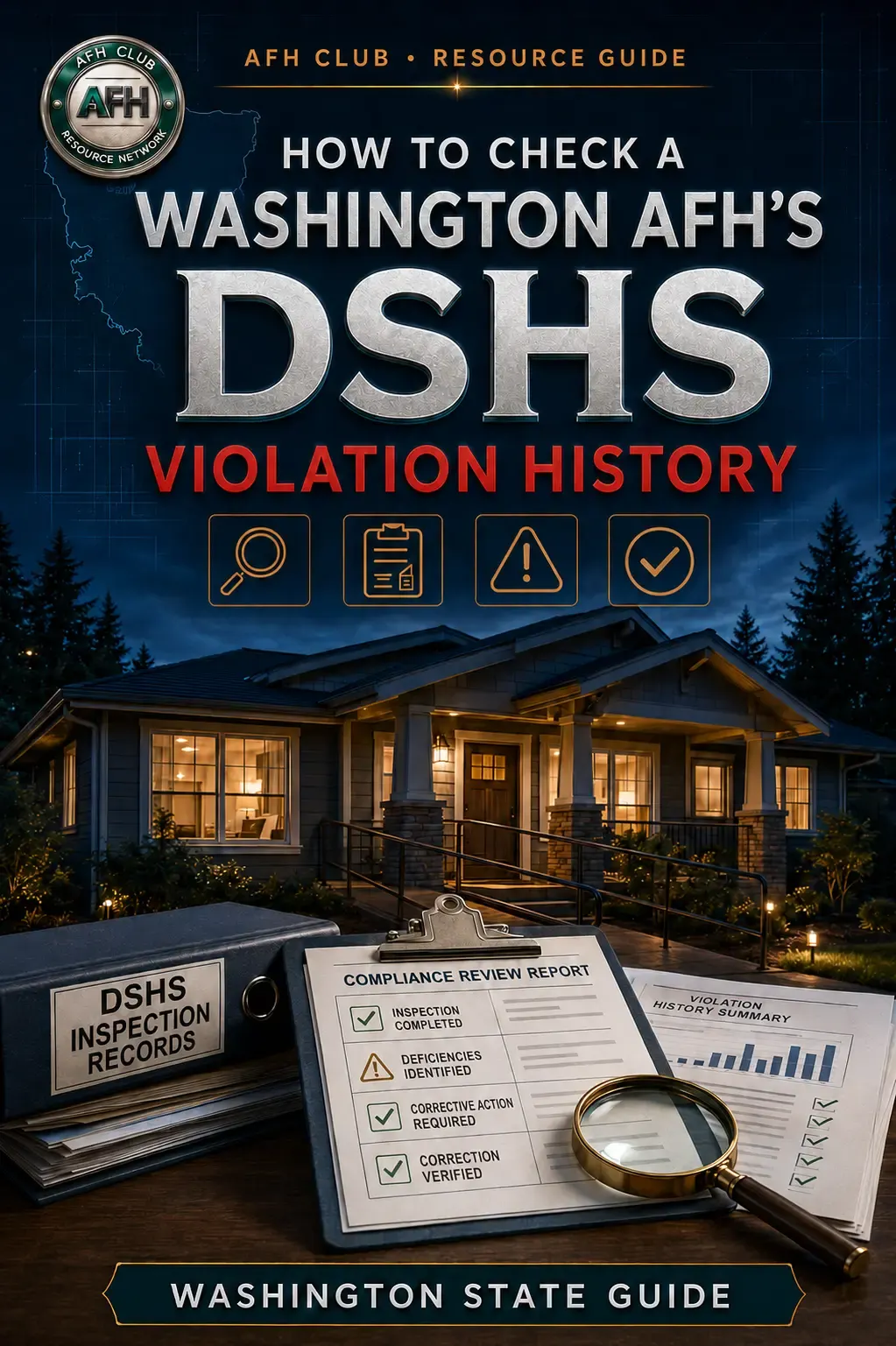
There is no "violations" button on the DSHS site. Instead, each home's listing in the DSHS Adult Family Home Locator links to its reports and inspection letters, where you will find inspection reports, deficiency citations, complaint investigation results, and enforcement letters.
Quick Answer:
- Go to the DSHS Adult Family Home Locator
- Search for the home
- Open the listing
- Open the home's reports and inspection letters
- Review inspections, deficiencies, corrections, and enforcement actions
What Counts as a Violation
AFHs must follow rules under Chapter 388-76 WAC and Chapter 70.128 RCW covering safety, care, staffing, medication, and operations.
A "deficiency" means a rule was not met — also called noncompliance or requirement not met. It does not automatically mean harm occurred.
Focus on severity, frequency, and response — not just the number of citations.
What Records Are Available
DSHS says the Locator shows limits and enforcement issued within the previous three years. The advanced search of enforcement letters goes back further, to actions from 2011. You may see:
- Inspection reports, including any cited deficiencies
- Complaint investigation results
- Enforcement letters, such as civil penalties, license conditions, or stop placement
- Limits on the type of residents the home can accept
Not every home will have every document.
The home itself must also keep a copy of every inspection report it received from DSHS in the past three years available for residents and the public to review (RCW 70.128.080). You can ask to see them. Licensed homes are inspected at least every 18 months, and up to every 24 months for a home with no citations on its last three inspections (RCW 70.128.070).
How to Look Up an AFH
- Go to the DSHS Adult Family Home Locator
- Search for the home by name or location
- Use the advanced search if needed (it also searches enforcement letters)
- Confirm the correct home (address, phone, license)
- Open the home's reports and inspection letters
- Open and read each document
- Match each issue to its outcome
If no documents are listed, it only means no documents are currently displayed.
How to Read an Inspection Report
Focus on this sequence:
- Facility details: name, license, dates
- Rule cited: look up WAC or RCW if needed
- What happened: evidence from records, interviews, or observation
- Correction: what was fixed and how
- Follow-up: whether DSHS confirmed compliance
What the Documents Mean
- Inspection report: the result of a licensing inspection. When DSHS finds the home out of compliance, it sends an inspection report citing each deficiency
- Investigation report: complaint reviewed
- Attestation of correction: the home's signed statement, returned within 10 calendar days, that it has corrected or will correct each deficiency by a date DSHS approves. The home keeps its own plan of correction and must show it to DSHS on request (WAC 388-76-10930, as amended September 20, 2026)
- Enforcement action: civil penalties, suspension or revocation of the license, or stop placement, which suspends admissions (RCW 70.128.160)
- License condition: conditions DSHS places on the license, such as correction within a set time, training, or limits on the type of residents the home may admit or serve
What It Means When No Documents Are Listed
It does not mean:
- No past violations
- No complaints
- A perfect history
It only means no documents are currently posted. Records may be limited, delayed, or incomplete.
How to Evaluate a Home
Look beyond the count of deficiencies:
- How recent is the issue
- Was there harm or risk
- Is it repeated or isolated
- How did the provider respond
- Did DSHS confirm compliance
- Was enforcement required
Example: One paperwork issue is very different from repeated medication errors.
Red Flags to Watch
- Repeated citations for the same issue
- Harm or serious safety risks
- Ongoing medication or staffing problems
- Missed correction deadlines
- Enforcement actions (fines, stop placements)
- Missing resolution details
These are not automatic deal-breakers, but they require follow-up.
Questions to Ask
- What caused the issue
- How was it corrected
- What prevents it from happening again
- Did DSHS confirm compliance
- Has it happened before
- Are any restrictions currently in place
Guidance for Buyers and Investors
Use the DSHS search as a starting point, not full due diligence.
- Search by name, address, and license number
- Review all reports, not just the latest
- Identify whether issues relate to current or prior operator
- Confirm active enforcement actions
- Ask the seller about any ongoing limits, exemptions, or outstanding enforcement on the current license
- Request older records
Also verify licensing, zoning, building compliance, and property condition.
Limits of the System
- Limits and enforcement are shown for the previous three years
- Posting delays can occur
- Some data is redacted
- Not all complaints appear publicly
- No deficiencies does not guarantee quality
Records do not show daily care quality, staff interaction, or fit for a specific resident.
Requesting More Information
Contact the Residential Care Services office for the area where the home is located, or submit a public records request to DSHS (online form, email DSHSPublicDisclosure@dshs.wa.gov, or call (360) 902-8484). Include:
- Facility name
- Address
- License number
- Date range
- Record types
Reporting a Concern
- Emergency: call 911
- DSHS Complaint Resolution Unit: 1-800-562-6078 (TTY 1-800-737-7931)
- Long-Term Care Ombudsman: available for independent support
Final Takeaway
Use the DSHS Locator and review the home's reports and inspection letters. Focus on the full story: what happened, how it was corrected, and whether compliance was restored.
Use records to guide better questions, not as a standalone decision tool.
This article is for general educational purposes and is not legal, medical, licensing, or real estate advice.
Your next questions
How do we choose between adult family homes?
Building a shortlist, what to ask on a tour, and a worksheet for comparing two homes side by side.
Which adult family homes are near us?
Every licensed adult family home in Washington, by city and county, with capacity, specialties and Medicaid contracts.
What does an adult family home cost?
Monthly costs by region and care level, including what Medicaid pays.
Will Medicaid pay, and what happens to the house?
Apple Health long-term care in Washington: eligibility, the home exemption, spend-down and the five-year look-back.