

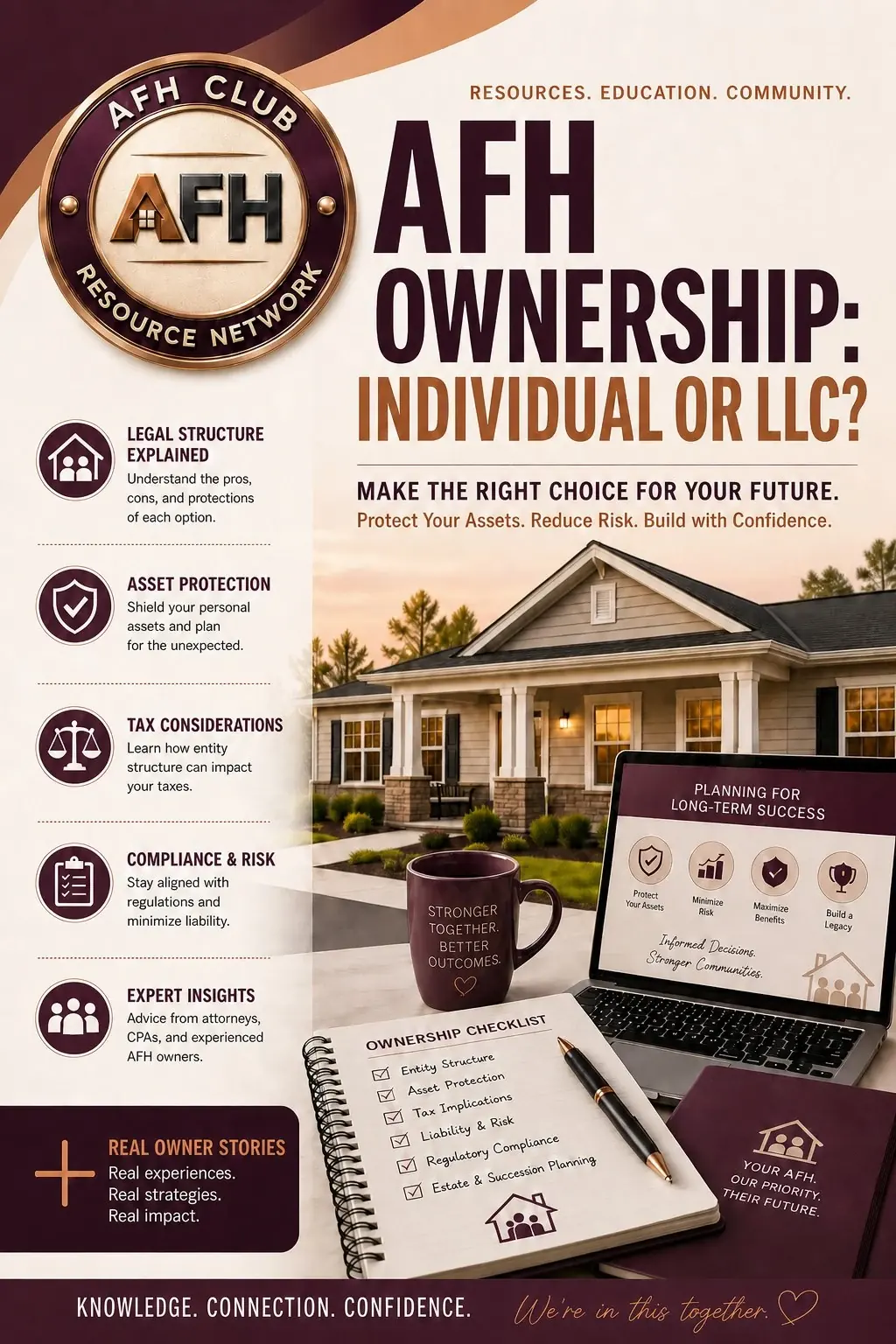
AFH Club · Ownership Structure
Should You Buy an Adult Family Home as an Individual or Through an LLC?
Buying an Adult Family Home is different from buying a typical house. In many cases, you are buying both a home and a business location — which makes ownership structure one of the most important early decisions a buyer can make.
Key Concept
Why Ownership Structure Matters
One of the first questions buyers ask is whether they should purchase the property in their own name or through a limited liability company, or LLC. There is no single right answer. The best choice depends on your financing, your risk tolerance, your tax and estate planning goals, and whether you are buying one AFH or planning to build a larger business.
When you buy an Adult Family Home, you are not just deciding how to hold title. You are also deciding how the property will be financed, how liability will be handled, and how easy it may be to transfer ownership later. For some buyers, simplicity is the priority. For others, liability protection matters more. In many cases, the right answer is a balance between convenience and protection.
Before you choose a structure, it is smart to talk with a lender early. The financing answer may influence the ownership structure before you even make an offer.
The Two Paths
Individual Ownership or an LLC
Buying as an individual
Buying an AFH in your own name is often the simplest option. The closing process is usually more straightforward, the paperwork is lighter, and financing may be easier to obtain. Many traditional lenders are more comfortable lending to an individual than to a newly formed LLC, which can make this route appealing for first-time buyers or owner-operators who want to move quickly. The tradeoff is liability exposure — if you own the property personally, your personal assets may be more exposed if a problem arises.
Buying through an LLC
Buying an AFH through an LLC is often attractive to buyers who want a clearer line between their personal assets and the property or business. An LLC can help create that separation. This structure can also be useful if you plan to own more than one AFH, bring in partners, or create a long-term business plan. The downside is that financing may be more complicated — lenders may require different underwriting, larger down payments, or higher interest rates, and there are added costs for forming and maintaining the entity.
Financing
Financing Differences
Financing is often one of the biggest differences between the two options. Lenders are usually more familiar with individual borrowers than with newly formed entities. If you buy in your own name, you may have a smoother path to conventional financing. If you buy through an LLC, the lender may treat the transaction more like a business loan, which can mean more paperwork and potentially less favorable terms.
Washington State
Washington State Considerations
In Washington State, DSHS licenses the provider that operates the home. The provider can be an individual or an entity such as an LLC, corporation or partnership. A license is not transferable (WAC 388-76-10010), so a buyer of an existing home applies for a new license, and the ownership structure decides who that applicant is.
- An entity must name an entity representative who meets the training and qualification requirements only an individual can meet (experience, training, background checks). One person can be the entity representative for only one entity provider (WAC 388-76-10090).
- Background checks reach the owners. The applicant and anyone affiliated with it (partners, officers, directors, the entity representative, the resident manager, a majority owner, and the applicant's spouse or domestic partner) need a Washington name and date of birth check and a national fingerprint check before licensure (WAC 388-76-10000, 388-76-10161). An entity application also lists homes or facilities where owners of five percent or more provided care in the last ten years.
- Changing structure later is a change of ownership. Forming an LLC or corporation to take over a licensed home, a merger, or a transfer of 50 percent or more of an entity's shares counts as a change of ownership, which means a new license application. Replacing the entity representative does not (WAC 388-76-10105).
- Holding the real estate separately has its own rule. If the building is leased or rented to the licensee and the property owner takes an active interest in running the home, the application must name the property owner (WAC 388-76-10095).
How an LLC or corporation is taxed depends on elections and your own situation; ask a CPA before you choose. For the B&O exemption and the federal live-in Medicaid income exclusion (which the IRS describes for individual providers), see Do Adult Family Homes Pay Taxes?.
Making the Decision
How to Decide
A simple way to think about it is to ask four questions. If ease and speed matter most, individual ownership may be the better fit. If protection and long-term structure matter more, an LLC may be worth the added complexity.
How important is financing simplicity?
Individual ownership generally offers a smoother, more familiar path to conventional financing. Lenders are typically more comfortable underwriting a loan to a person than to a newly formed entity.
How important is liability separation?
An LLC can create a clearer line between your personal assets and the property or business. If liability protection is a top priority, this separation may outweigh the added complexity.
Am I buying one home or building a larger business?
If you plan to own more than one Adult Family Home, bring in partners, or build a long-term operation, an LLC structure is often better suited to support that growth.
Do I need a structure that supports future partners or planning?
For buyers thinking beyond a single purchase, an LLC can make it easier to add partners, plan for succession, or organize multiple properties under one structure over time.
Final Thoughts
There Is No Single Best Answer
The right structure depends on your goals, your lender, your legal planning, and the way you intend to operate the home. If you are considering an Adult Family Home purchase in Washington State, it helps to think about both the real estate and business sides of the transaction. The right structure can make the purchase easier to finance, easier to manage, and better aligned with your long-term plans.
Buying an AFH
Planning an AFH Purchase?
You can contact AFH Club's featured Washington licensed broker or certified appraiser, who work with Adult Family Homes, directly. Licensed work is done by those professionals through their own practices.
Professional Disclosure
Real Property Planning is an educational and connection hub. It does not provide legal, tax, accounting, financial, brokerage, or appraisal services. Professionals referenced on this site are independently licensed and operate through their own separate businesses. Real estate brokerage services are provided by David Stein, a licensed Washington broker, through eXp Realty. Appraisal services are provided by David Stein through Stein Appraisal. Read the full disclaimer.